If you spend a lot of time on the foredeck, you already know that a well-designed bow pulpit can make the difference between feeling relaxed and feeling like you are one slip away from disaster. The right rail gives you something solid to lean on when you are dealing with an anchor, furling a headsail, or stepping onto a pontoon. In this guide, you will walk through how to choose the right bow pulpit for your boat in a practical, step-by-step way, so you can avoid expensive mistakes and get a set-up that actually suits the way you sail or cruise.
What Is a Bow Pulpit for Boat?
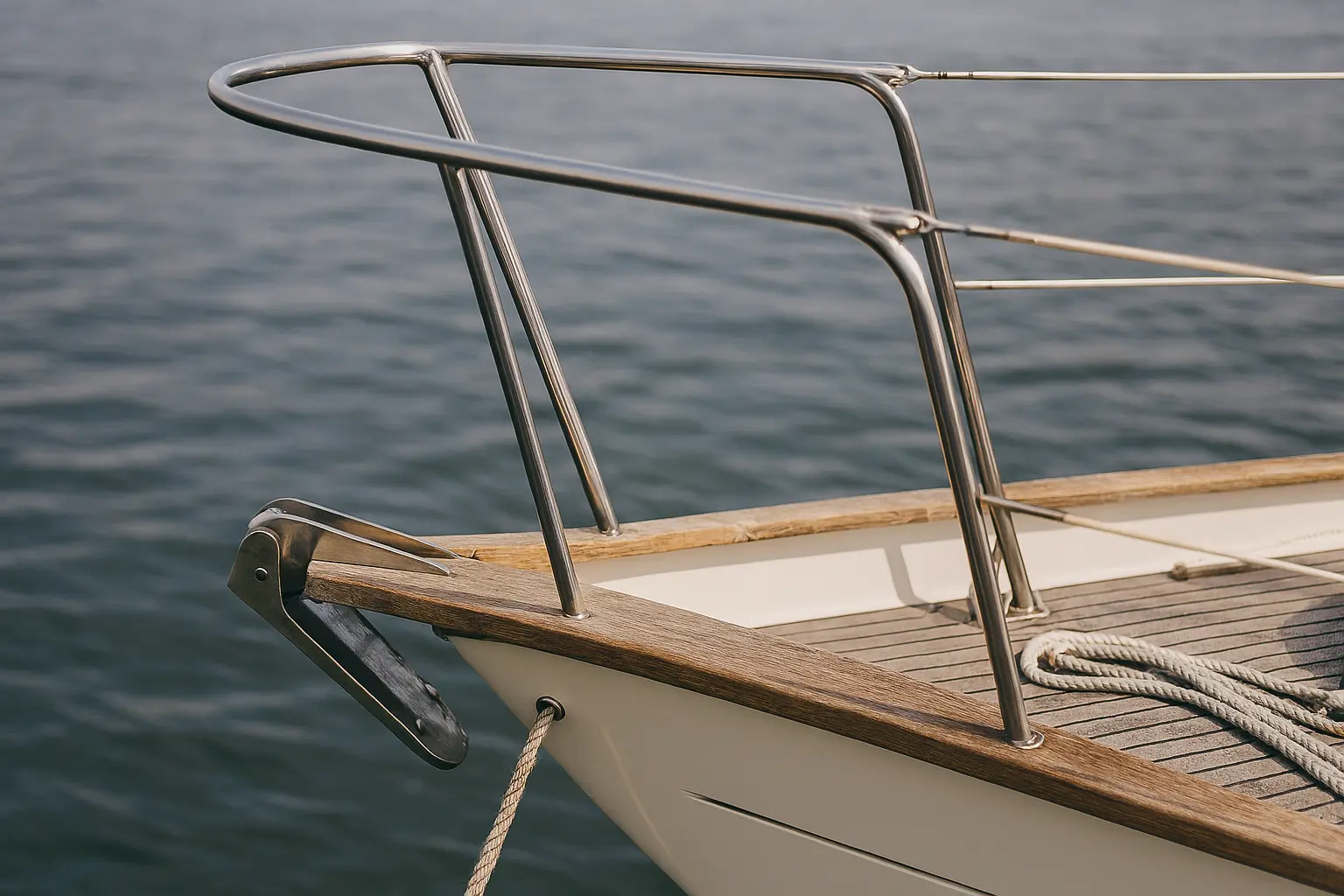
A bow pulpit is the rigid rail or guard structure mounted at the very front of your boat. It usually forms part of the guardrail system, connecting to side stanchions and lifelines, and it is designed to give you a secure handhold and physical barrier when you are working on the foredeck. Most pulpits are built from tubular metal (often stainless steel), shaped to match the sheer and bow profile of the hull.
On many modern cruisers the bow pulpit also supports navigation lights, bow rollers, anchor housings and sometimes even small seats. On smaller boats it may be simpler, perhaps just a curved rail that helps you move confidently right up to the stem. Because this one piece of hardware connects directly to your deck structure, rig loads and ground tackle, choosing it carefully is about much more than looks.
Bow Pulpit vs Bowsprit: Key Differences
It is easy to mix up ‘bow pulpit’ and ‘bowsprit’ because both sit at the front of the boat. In reality, they do very different jobs. Understanding this distinction will help you shop for the correct gear and avoid buying a structure that is not designed for the loads you have in mind.
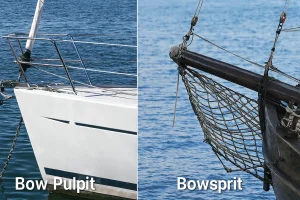
| Feature | Bow pulpit | Bowsprit | Typical use |
|---|---|---|---|
| Main purpose | Safety rail and work platform at the bow | Structural extension forward of the bow | Deck safety vs sail/anchor handling performance |
| Primary loads | Human weight, minor hardware loads | Rigging loads, anchors, sails | Crew stability vs running rig loads |
| Typical construction | Tubular rail structure with multiple legs | Beam, platform or pole projecting ahead of stem | Guardrail system vs rigging/anchor support |
| Common on | Cruising yachts, motorboats, small craft | Traditional yachts, performance cruisers, some motorboats | General cruising vs specialised rigs |
Source: General practice in production yacht design and rigging manuals from major manufacturers.
In short, the bow pulpit is there to protect you, while the bowsprit is there to help the boat carry sails or ground tackle in a better position. You may have both, but they are not interchangeable.
Common Uses of a Bow Pulpit
Once you start listing what you actually do at the front of your boat, the importance of the pulpit becomes very obvious. In everyday use you may rely on it to:
- Move safely forward when dropping, weighing, or snubbing the anchor.
- Clip on a safety harness attachment point or tether when working near the stem.
- Support combined port and starboard navigation lights or a tricolour.
- Provide a mounting point for bow rollers, anchor housings or a small anchor platform.
- Offer a place to lean or sit while watching for pots, logs or shallow patches.
On some motorboats, the bow rail also frames a sunpad or seating area, which makes a strong, well-designed pulpit a key piece of comfort equipment as well as a safety feature. If you cruise with children or less experienced crew, the bow pulpit safety considerations become even more important, because people naturally gravitate to the bow underway.
Types of Bow Pulpits
Although every boat builder has their own design language, most bow pulpits fall into a few broad categories.
- One-piece wraparound pulpits: A continuous rail that wraps around the bow and connects to the side decks. These are common on production cruising yachts and motorboats.
- Split or open-front pulpits: The pulpit is open at the stem, allowing a furler or anchor roller to pass through the gap. This layout makes anchor and sail handling easier but requires careful design to remain strong.
- Integrated platforms: Some designs incorporate a small platform or ‘step’ ahead of the deck, giving you somewhere to stand above the anchor or chain. These are popular on larger cruisers and some powerboats.
- Custom or extended designs: On retrofits, owners sometimes specify a heavy-duty bow pulpit with extra supports to carry powerful anchor windlasses, dual rollers or even small bow seats.
When you shop, you may see catalogue pulpits described mainly by overall width, height and the distance between leg centres. For a really clean fit, you may still want a fabricator to tweak or custom-build the frame so it properly follows your deck camber and hull lines.
7 Expert Tips for Choosing a Boat Bow Pulpit
Before you pick the first shiny rail that looks roughly the right shape, step back and think about what to consider when buying a bow pulpit. The seven tips below are built around real-world use rather than just brochure photos. They will help you choose the best bow pulpit for boat in your size and usage range, without overspending in the wrong areas.
1. Tip 1: Prioritise Safety and Stability
Everything starts with safety. The core job of a bow pulpit is to keep you on the boat. That means its height, shape, and number of legs all matter. If the rail is too low, you will always feel as though you are about to topple over it. If it is too high or too far aft, you may not be able to reach the anchor, furling drum or mooring line properly.
When you stand at the bow, your hips should be well inside the rail when you lean forwards. Check that there is at least one solid place to hold with both hands while you work. Look for extra diagonals or bracing pieces that keep the structure rigid when someone leans heavily on it or a wave hits it sideways. These little triangles of metal often make the difference between a rail that merely vibrates and one that inspires confidence in rough weather.
From a design point of view, you should ensure that the rail has no awkward ‘trip’ points at deck level, that it aligns smoothly with the side stanchions and that it is clearly strong enough for you to grab instinctively in an emergency. If you regularly sail at night or in rough conditions, focus on how to choose a safe bow pulpit for boat usage rather than just what looks attractive in photos.
2. Tip 2: Choose the Right Material: Stainless Bow Pulpit vs Alumninium vs Composite
Most modern boats use stainless steel for their pulpits, but it is not the only option. You may also see aluminium or composite constructions on some designs. Your choice of material affects strength, weight, longevity and price, so it is worth understanding the trade-offs before you commit to a particular stainless bow pulpit or alternative.
| Material | Main advantages | Main limitations | Typical use |
|---|---|---|---|
| Stainless steel (marine grade) | High strength, good shine, strong welds, excellent durability | Heavier than aluminium, higher cost | Common standard on cruising yachts and motorboats |
| Aluminium | Lighter weight, can be cheaper in some markets | Requires careful coating, more vulnerable to corrosion if neglected | Performance-oriented or weight-sensitive designs |
| Composite/GRP | Can be moulded into complex shapes, integrated look | Repair and modification can be more involved | Custom or high-end builds |
Source: Typical specifications from marine hardware catalogues and boatbuilder fit-out guides.
For most owners, a well-fabricated stainless steel pulpit will be the default, simply because it offers the best balance of strength and corrosion resistance for the price. When comparing a stainless steel bow pulpit with an aluminium one, think about how you actually use your boat. If you cruise in warm, salty water and leave the boat on a mooring for long periods, durable bow pulpit materials for saltwater are essential. Look for smooth welds, properly polished tube and secure mounting bases to ensure a genuinely corrosion-resistant bow pulpit rather than one that will pit and stain your deck in a few seasons.
Aluminium can make sense if weight is at an absolute premium or if your boat already has an all-aluminium rail system. In that case, ask the fabricator directly which material is best for the bow pulpit on your specific hull, taking into account local conditions and how often you are willing to inspect and maintain protective coatings.
3. Tip 3: Match Size to Boat Specifications
The next step is to get the size right. You cannot simply pick a ‘medium’ or ‘large’ pulpit and hope it fits. This is where many owners get frustrated, because a misplaced leg or an incorrect height can turn a tidy upgrade into a long, messy refit. Think of this stage as your own mini project on how to select bow pulpit size for boat rather than a quick guess.
At a minimum, you will need to measure the distance between the existing mounting holes (if you are replacing an old pulpit), the width of the bow at the intended rail position and the distance aft to where the pulpit should meet the side deck. Note any deck camber or crown, because a perfectly flat base will not sit correctly on a curved surface without shims or custom bases. If you have no existing pulpit, stand where you imagine the legs should land and check what is underneath – you want solid structure, not just thin deck laminate.
Many owners also take this opportunity to slightly adjust the geometry to suit their own height. For example, taller skippers may prefer a fractionally higher rail so that it hits comfortably at mid-thigh when moving forward in a seaway. Smaller boats, especially those on trailers, may benefit from a more compact frame so that the best bow pulpit for small boats still allows the tow vehicle to turn without clouting the rail.
| Check item | Why it matters | What to look for |
|---|---|---|
| Leg spacing | Ensures loads transfer into strong deck areas | Alignment with bulkheads, knees or reinforced zones |
| Rail height | Comfort and security when leaning on the rail | Hits mid-thigh or higher for typical crew height |
| Overall width | Clear movement at the bow and trailer clearance | Enough room to work but not so wide it catches everything |
| Integration with rollers | Avoids anchor fouling the rail | Anchor clears the rail and hull in all positions |
Source: Common recommendations in small-boat design and refit guides.
If you are not confident reading plans or measuring complex curves, consider asking a local metalworker or boatyard to check your measurements before ordering. It is far cheaper to pay for an hour of professional time than it is to rework a misaligned pulpit later.
Read More: How to Measure the Beam of a Boat: 3 Methods Explained
4. Tip 4: Consider Boat Type and Usage
The ‘right’ pulpit for a gentle inland cruiser is not necessarily the right one for an offshore yacht. Before you buy, think honestly about how, where and how often you use your boat. A dayboat that mostly potters around sheltered water needs less extreme hardware than a workboat that runs in rough chop every day.
If you run a commercial tour boat or a work RIB, you may already be familiar with upgrading deck gear when you change propulsion systems or payloads. Many operators who move to electric outboard systems, for instance, also revisit their bow layout to handle new anchoring patterns and loading profiles, often taking inspiration from case studies on high-usage commercial craft. In these cases, specifying a stiffer, more heavily braced pulpit with additional support legs or gussets can be a wise investment.
For private leisure boats, ask yourself these questions:
- Do you anchor frequently in swell or current, where you may need to go forward quickly and often?
- Do you cruise with small children or non-sailors who are likely to stand at the bow while underway?
- Is your boat often alongside high quays or rough pilings where the pulpit may take knocks?
- Do you need extra space for gear such as fenders, paddleboards or chain snubbers at the bow?
Your answers will determine whether you can live with a lighter rail or whether you really need something close to a commercial-spec, heavy-duty bow pulpit with more robust mounting and thicker tube.
Read More: What Boat Types Are Suitable for a 70HP Outboard Motor? (2025)
5. Tip 5: Check Manufacturer Standards and Certification
A good pulpit is not just ‘some bent tube’. Reputable builders design their guardrails to comply with recognised safety standards and to integrate with the overall deck structure. When you are choosing a replacement or aftermarket unit, you want to see the same level of care.
Look for evidence that the maker follows relevant small-craft standards for guardrail height, spacing and strength, even if they do not quote chapter and verse in their brochure. Ask how they test their welds and what grade of fasteners they supply with the bases. If possible, choose a fabricator who can provide drawings for approval before building, so you can confirm that the rail will clear furling drums, bow rollers and any existing stem fittings.
For production boats, many owners prefer to source a pulpit directly from the original manufacturer or one of their approved suppliers. This improves your chances of a perfect fit and ensures that the new rail is compatible with existing lifelines and stanchion layout. It can also simplify future resale conversations, because buyers like to see that major items of safety hardware have been replaced with like-for-like parts rather than improvised fabrications.
6. Tip 6: Verify Ease of Installation and Maintenance
Even the strongest pulpit will disappoint you if it is a nightmare to install or maintain. Before you sign off on an order, think through the practical steps involved in getting it on the boat and keeping it in good shape. This is where a simple bow pulpit installation guide can save time and reduce stress.
Ideally, all mounting bases should be accessible from below so that you can fit backing plates and large washers, not just penny washers on thin laminate. Check whether any interior linings, lockers or chain lockers will need to be removed to reach the nuts. If so, factor that labour into your budget. Also consider whether the new rail will require re-routing any wiring to navigation lights or fitting new conduit along the deck.
When it comes to upkeep, you want smooth, easy-to-clean surfaces. Polished stainless tube helps you spot early signs of tea-staining or rust blooms, so you can tackle them before they become serious. Avoid designs with awkward dirt traps, hidden corners or tight crevices that are difficult to rinse after a salty passage.
If you are planning to do the work yourself, look for makers who provide clear advice on how to measure your boat for bow pulpit installation, including templates or dimensioned sketches. This will increase your chances of getting a rail that drops into place with minimal adjustment rather than one that needs extensive bending or cutting to fit.
7. Tip 7: Balance Budget with Quality
Finally, you need to bring cost into the picture. It is tempting to hunt for the lowest quote and call it a day, but a pulpit is one of those items where false economy can haunt you for years. A high-quality bow pulpit at low cost is not impossible, but you will only get close if you understand where you can safely compromise and where you should not.
In broad terms, you are paying for three things: materials, labour and design. Thinner tube, fewer legs and rougher polishing will save money, but they will also reduce strength and may make the rail less pleasant to use every day. On the other hand, a beautifully polished, over-engineered structure with complex curves may offer little extra real-world benefit on a modest coastal cruiser.
As you compare quotes for what looks like the best bow pulpit for boat in your class, ask each supplier to break down what you are getting for the price. Do they include proper backing plates and quality fasteners? Will they adjust the frame if your first trial fit shows a clash with existing hardware? Once you have those details, you can decide whether a mid-range option actually offers better value than the cheapest or dearest on the list.
Installation Tips for Bow Pulpits
Once you have chosen a rail, getting it onto the boat safely is the next challenge. Even if you hire a yard to do the work, understanding the basic steps will help you spot shortcuts and ask better questions. Think of this as your condensed, practical bow pulpit installation guide that you can mentally run through before anyone starts drilling holes in your deck.
Start by dry-fitting the new rail without sealant. Gently lower it into place and check that all legs sit flat on the deck without forcing them into alignment. If a base rocks or leaves a visible gap, do not simply tighten the bolts and hope for the best. Instead, mark the high spots and talk to your installer about shimming, fairing the deck slightly or adjusting the leg length. Bolting down a twisted frame stores up stress that can crack the gelcoat or loosen over time.
Next, confirm that all mounting points land on strong structure. If the deck under a base feels thin or flexes when you press on it, you may need to add local reinforcement inside, such as laminated pads, timber or composite blocks. This step turns the pulpit into a truly integrated part of the boat rather than just a decorative add-on.
Only after you are happy with the dry fit should you move on to sealing and bolting. Use a suitable marine sealant around each fastener hole and under each base, following the manufacturer’s instructions. Tighten the bolts gradually and evenly, so you do not squeeze all the sealant out in one go. Once everything is secure, clean away excess sealant before it cures fully, leaving a neat finish.
At this stage, test the rail in real-world conditions. Have a crew member lean hard on each section and simulate the kind of movements you make when dealing with anchors or mooring lines. Listen for creaks and watch for movement. If anything feels vague, address it immediately rather than promising yourself you will sort it ‘later’.
If you are also fitting new ground tackle at the same time, double-check that the anchor swings freely past the rail and does not bang into it when you deploy or retrieve. Careful planning at this stage makes it far easier to how to upgrade your boat’s bow pulpit and anchoring system together without constant minor modifications afterwards.
Read More: How to Choose the Right Electric Outboard Motor for Your Boat: A Quick Guide
Conclusion
Choosing a bow rail is about much more than picking a shiny piece of metal that vaguely fits the front of your boat. When you break the decision down into clear steps – safety, materials, sizing, usage, standards, installation and budget – it becomes much easier to see which options genuinely work for your style of boating. You move from guesswork to a structured way of thinking about bow pulpit design.
By now, you should have a practical sense of how to choose the right bow pulpit for your boat without getting lost in catalogue jargon. You know why a well-thought-through stainless bow pulpit often earns its keep over many seasons, where lighter or more experimental materials might make sense, and how to spot a design that will actually be pleasant and safe to use in real conditions.
As you compare models and quotes, keep returning to your real-world needs. Picture yourself moving along the side deck on a lumpy day, or leaning forward to free a stubborn anchor in a tight anchorage. If a proposed design makes those moments feel calmer and easier, you are probably looking at the best bow pulpit for boat in your situation. If it does not, keep asking questions until you find one
Frequently Asked Questions
What is a bow pulpit used for?
A bow pulpit is primarily used as a safety rail and working area at the front of your boat. It gives you something solid to hold while you manage the anchor, sails, mooring lines or fenders, and it often carries navigation lights or bow rollers. In short, it lets you move confidently right up to the stem without feeling as though you are about to fall overboard.
How is a bow pulpit different from a bowsprit?
A bow pulpit is a guardrail structure designed for people to hold and lean on, while a bowsprit is a structural extension that carries loads from sails or anchors. You stand inside the pulpit; you usually do not stand on the bowsprit unless it has been designed as a working platform. Mixing up the two can lead to hardware being used in ways it was never designed to handle.
Can I install a bow pulpit on any boat?
In principle, you can fit a bow pulpit to many small craft, but it must be matched to the hull shape and deck structure. Some open boats and very small dinghies lack the reinforcement needed to carry a rail safely. Before you commit, inspect the bow area from inside to make sure there is enough solid material to support the bases and backing plates. If in doubt, ask a boatbuilder or surveyor to assess the feasibility.
Are stainless steel bow pulpits better than aluminium?
For most leisure boats, stainless steel pulpits offer the best mix of strength, durability and ease of maintenance. Aluminium rails can be lighter and work well on certain performance designs, but they demand more careful protection against corrosion and impact. If you keep your boat in saltwater and want low-maintenance reliability, a well-built stainless rail is usually the safer long-term choice.
How do I measure my boat for a bow pulpit?
To measure your boat, start by noting the distance between any existing mounting holes, then measure the width of the bow where the rail will sit and the distance aft to where it should meet the side deck. Check the deck camber and the position of bulkheads or knees under the deck, so you can line up the new bases with strong structure. If the maker offers templates or a measurement sheet, follow it carefully – this is the most straightforward way to avoid surprises during installation.
Where can I find bow pulpit for sale?
You can find bow pulpits through boatbuilders, chandlery suppliers, metal fabricators and specialist rail manufacturers. For production boats, starting with the original builder or their parts network often gives the best fit. For older or custom craft, a local fabricator who regularly works on marine projects can design and build a rail that matches your hull and your specific needs.
that does – your future self on the foredeck will thank you for taking the time now.
References
Classroom. (2025, February 6). Pulpit – Nautical Know-How Glossary. MySailingCourse. https://classroom.mysailingcourse.com/glossary/pulpit/
Odyssey Yachts. (2015, 25 September). Bow Pulpit. Odyssey Yachts Building Blog. https://odysseyyachts.com/Odyssey_Yachts/BUILDING_BLOG/Entries/2015/9/25_Bow_Pulpit.html
The Bosun. (2023, 11 April). Bow Pulpit: The Essential Guide. The-Bosun.com. https://the-bosun.com/bow-pulpit-the-essential-guide/ the-bosun.com
World Sailing. (2016). Offshore Special Regulations (OSR) 2016 – lifelines, pulpits and stanchions requirements. https://www.sailing.org/tools/documents/OSR2016mo3life23032016-[19872].pdf sailing.org
Cedric Marina Ltd. (2025, May 3). Installing Boat Railings: Safety, Materials & Design Tips. CedricMarina.com. https://cedricmarina.com/installing-boat-railings/